↖ All Publications

arXiv Preprint

CaDIS

2020 CATARACTS Semantic Segmentation Challenge

I. Luengo, M. Grammatikopoulou, et al., C.I. Nwoye, D. Alapatt, N. Padoy, et al.

Multiple institutions including ICube, University of Strasbourg, CNRS, France

An international challenge for semantic segmentation of surgical instruments and anatomical structures in cataract surgery videos, introducing the CaDIS dataset.

Abstract

Semantic segmentation of surgical scenes is essential for context-aware assistance in ophthalmic surgery. We present the 2020 CATARACTS Semantic Segmentation Challenge, organized to advance automated scene understanding in cataract surgery videos. The challenge uses the CaDIS dataset, which provides pixel-level annotations for instruments, anatomy, and other structures across three increasingly difficult tasks. Multiple teams submitted deep learning methods, and this paper provides a comprehensive analysis of their approaches and results.

Demo

Demo
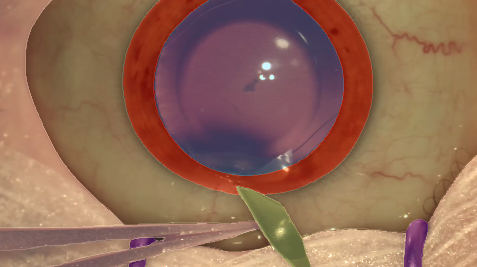
Semantic segmentation overlays on cataract surgery frames: instruments, anatomy, and other structures are labeled at pixel level.
Demo
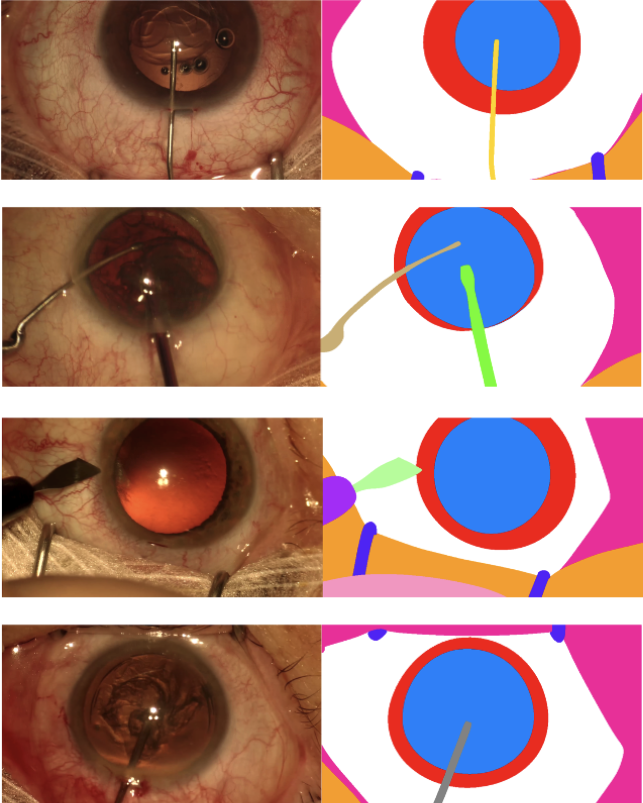
Examples from the CaDIS dataset showing the diversity of cataract surgery scenes and their corresponding segmentation annotations across training and test sets.

Method

Method
The CATARACTS challenge setup: three tasks of increasing difficulty, from basic instrument segmentation to full scene parsing with 36 classes.

The challenge comprised three segmentation tasks:

  • Task 1: Segmentation of surgical instruments (8 classes)
  • Task 2: Segmentation of instruments and anatomy (17 classes)
  • Task 3: Full scene segmentation including rare structures (36 classes)

Research Coverage

  • Dataset: CaDIS -- 4,670 annotated frames from 25 cataract surgery videos with pixel-level labels
  • Scope: International challenge with multiple participating teams and deep learning approaches
  • Analysis: Per-task and per-class evaluation, comparison of architectures (U-Net, DeepLab, etc.)
  • Domain: Ophthalmic surgery, semantic segmentation

Results and Findings
Results and Findings
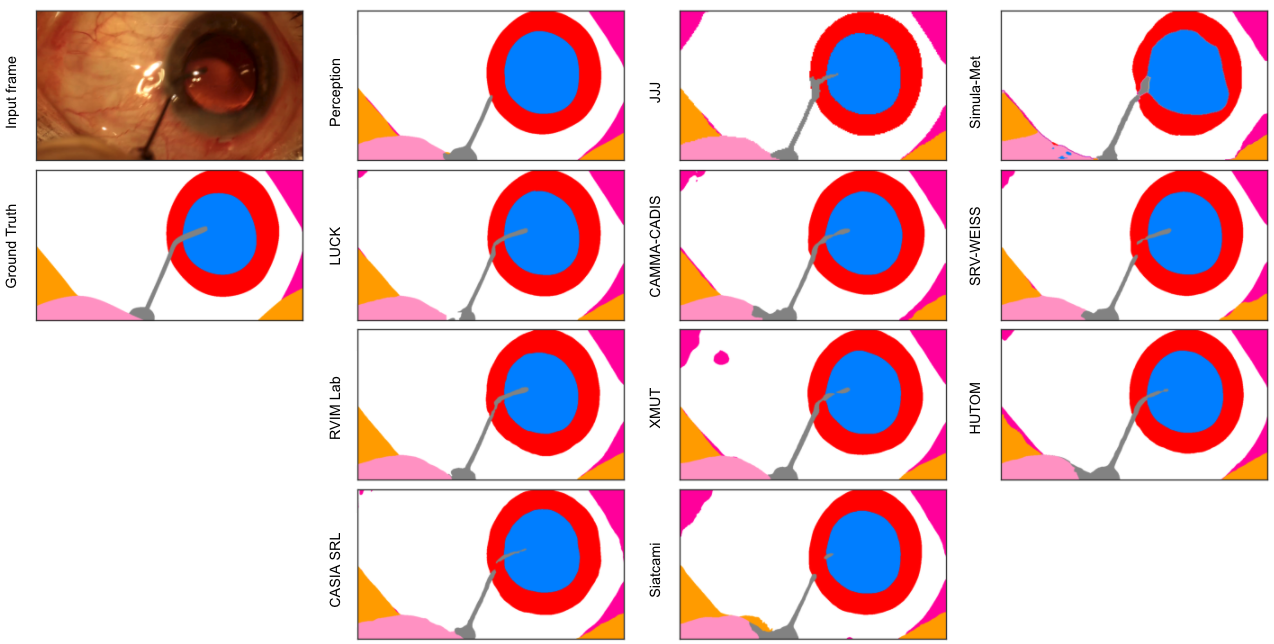
Qualitative segmentation results from top-performing methods on Task 1, showing accurate instrument delineation.
  • Task complexity significantly affects performance: mean IoU drops from 80%+ (Task 1) to under 50% (Task 3)
  • Encoder-decoder architectures with attention modules achieved the best results
  • Rare class segmentation remains a major challenge across all submitted methods

Citation

@article{luengo2021cataracts,
  title={2020 CATARACTS semantic segmentation challenge},
  author={Luengo, Imanol and Grammatikopoulou, Maria and others},
  journal={arXiv preprint arXiv:2110.10965},
  year={2021}
}