↖ All Publications

IPCAI 2019 · Oral · Audience Choice Best Paper Award

ConvLSTM Tracker

Weakly Supervised Convolutional LSTM Approach for Tool Tracking in Laparoscopic Videos

C.I. Nwoye, D. Mutter, J. Marescaux, N. Padoy

ICube, University of Strasbourg, CNRS, France · IHU Strasbourg, France

A weakly supervised deep learning method for surgical tool tracking using only binary tool presence labels, leveraging ConvLSTM for temporal modeling. Now integrated in the NVIDIA Holoscan SDK for real-time surgical AI.

Abstract

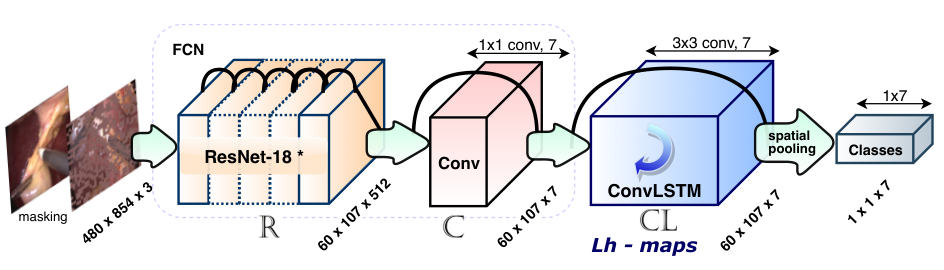
Surgical tool tracking is an essential but challenging task in computer-assisted interventions. We propose a weakly supervised approach for tool tracking in laparoscopic videos that relies only on binary tool presence labels for training. Our method leverages convolutional LSTM to model the temporal evolution of class activation maps (CAMs), enabling the network to learn smooth spatial tool localizations over time without requiring any bounding box or pixel-level annotations during training. The approach generates tool presence detection, spatial localization, and motion tracking in a unified framework.

Demo

Demo
Real-time surgical tool tracking using only binary presence labels for training -- no bounding box annotations needed.

Method

Method
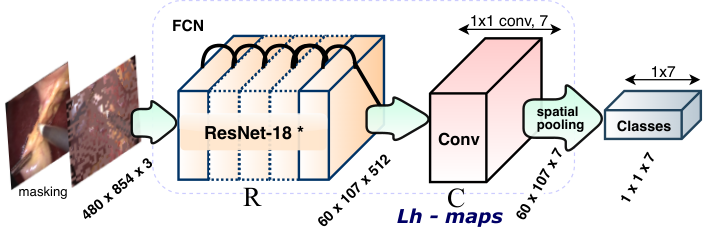
The ConvLSTM tracker architecture: a CNN backbone generates class activation maps (CAMs) which are temporally refined by a ConvLSTM module for smooth spatial localization.
  • Weak supervision: Only binary tool presence/absence labels are needed -- no bounding boxes or segmentation masks
  • ConvLSTM temporal modeling: Class activation maps from a CNN are fed into a ConvLSTM to enforce temporal consistency and smooth spatial localization
  • Unified framework: Simultaneously performs tool detection, localization, and tracking

Research Coverage

  • Dataset: Cholec80 (80 cholecystectomy videos) and m2cai16-tool (15 videos)
  • Scope: First weakly supervised approach to achieve competitive tool tracking in surgical videos
  • Domain: Laparoscopic cholecystectomy
  • Industry adoption: Integrated into the NVIDIA Holoscan SDK for real-time endoscopy AI applications

Results and Findings

Results and Findings
Comparison of spatial localization: ConvLSTM produces smoother, more accurate tool tracking than static CAM approaches.
  • Achieves tracking performance competitive with fully supervised methods while requiring only binary presence labels
  • ConvLSTM improves localization accuracy by 7.8% over static CAM approaches
  • Won the IPCAI 2019 Audience Choice Award for Best Paper Presentation
  • Adopted by NVIDIA as a reference model in the Holoscan SDK for surgical tool tracking

Citation

@article{nwoye2019weakly,
  title={Weakly supervised convolutional LSTM approach for tool tracking in laparoscopic videos},
  author={Nwoye, Chinedu Innocent and Mutter, Didier and Marescaux, Jacques and Padoy, Nicolas},
  journal={International Journal of Computer Assisted Radiology and Surgery},
  volume={14},
  pages={1059--1067},
  year={2019},
  publisher={Springer}
}