↖ All Publications

Université de Strasbourg · Thesis Prize 2022

Ph.D. Thesis

Deep Learning Methods for the Detection and Recognition of Surgical Tools and Activities in Laparoscopic Videos

C.I. Nwoye

ICube, University of Strasbourg, CNRS, France · IHU Strasbourg, France

Doctoral thesis introducing the surgical action triplet paradigm for fine-grained surgical activity recognition, and developing foundational methods and datasets that have shaped the field.

Abstract

This thesis addresses the challenge of understanding surgical activities from endoscopic videos. We introduce the concept of surgical action triplets -- structured representations of instrument-tissue interactions as -- as a new paradigm for fine-grained surgical activity recognition. We develop three foundational methods: (1) a weakly supervised ConvLSTM approach for surgical tool tracking, (2) Tripnet for end-to-end action triplet recognition, and (3) Rendezvous, an attention-based model for joint spatial and semantic reasoning over triplet components. We also create the CholecT40, CholecT45, and CholecT50 datasets, the first large-scale benchmarks for surgical action triplet recognition. This work has led to two international challenges at MICCAI and has been adopted by the community as a standard task in surgical AI.

Demo

Demo
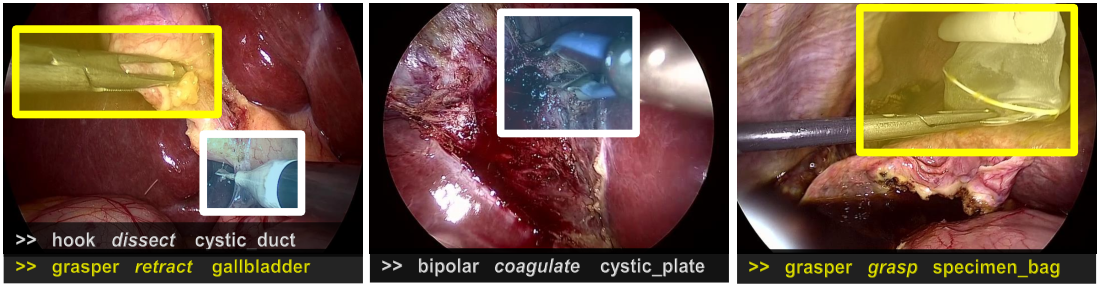
The surgical action triplet paradigm introduced in this thesis: modeling fine-grained surgical activities as <instrument, verb, target> triplets.

Method

Method
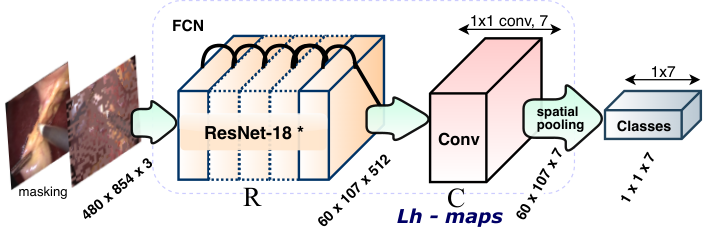
ConvLSTM Tracker (IPCAI 2019): weakly supervised tool tracking using temporal class activation maps.
Method
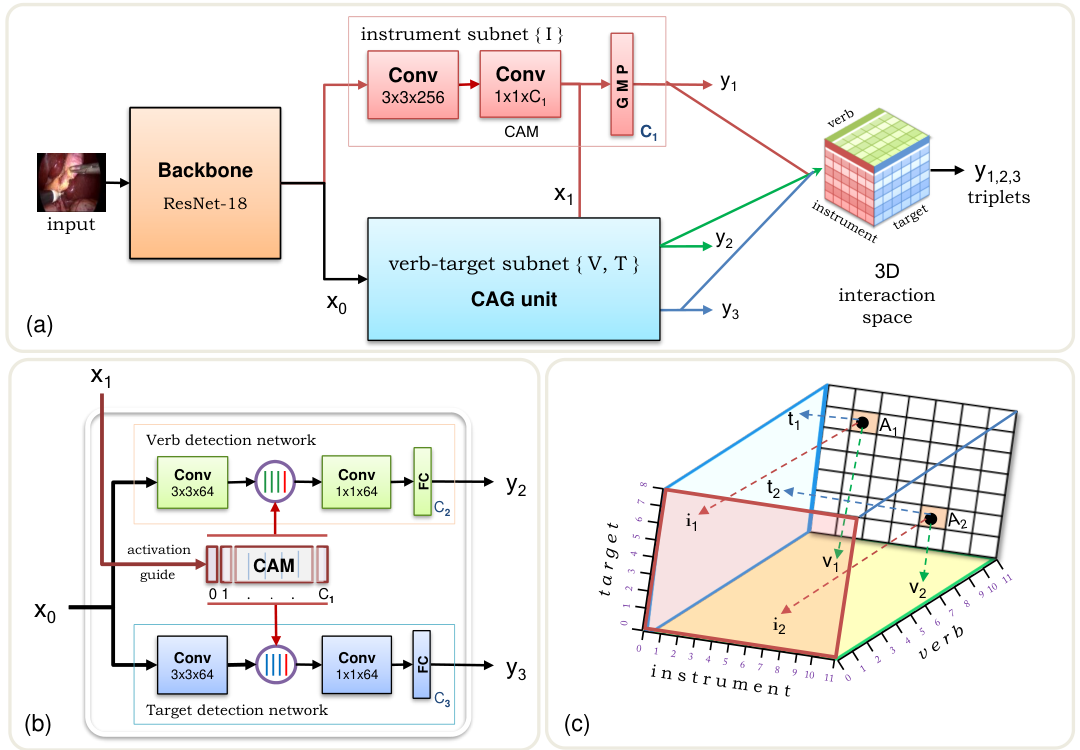
Tripnet (MICCAI 2020): 3-stage architecture for end-to-end surgical action triplet recognition.
Method
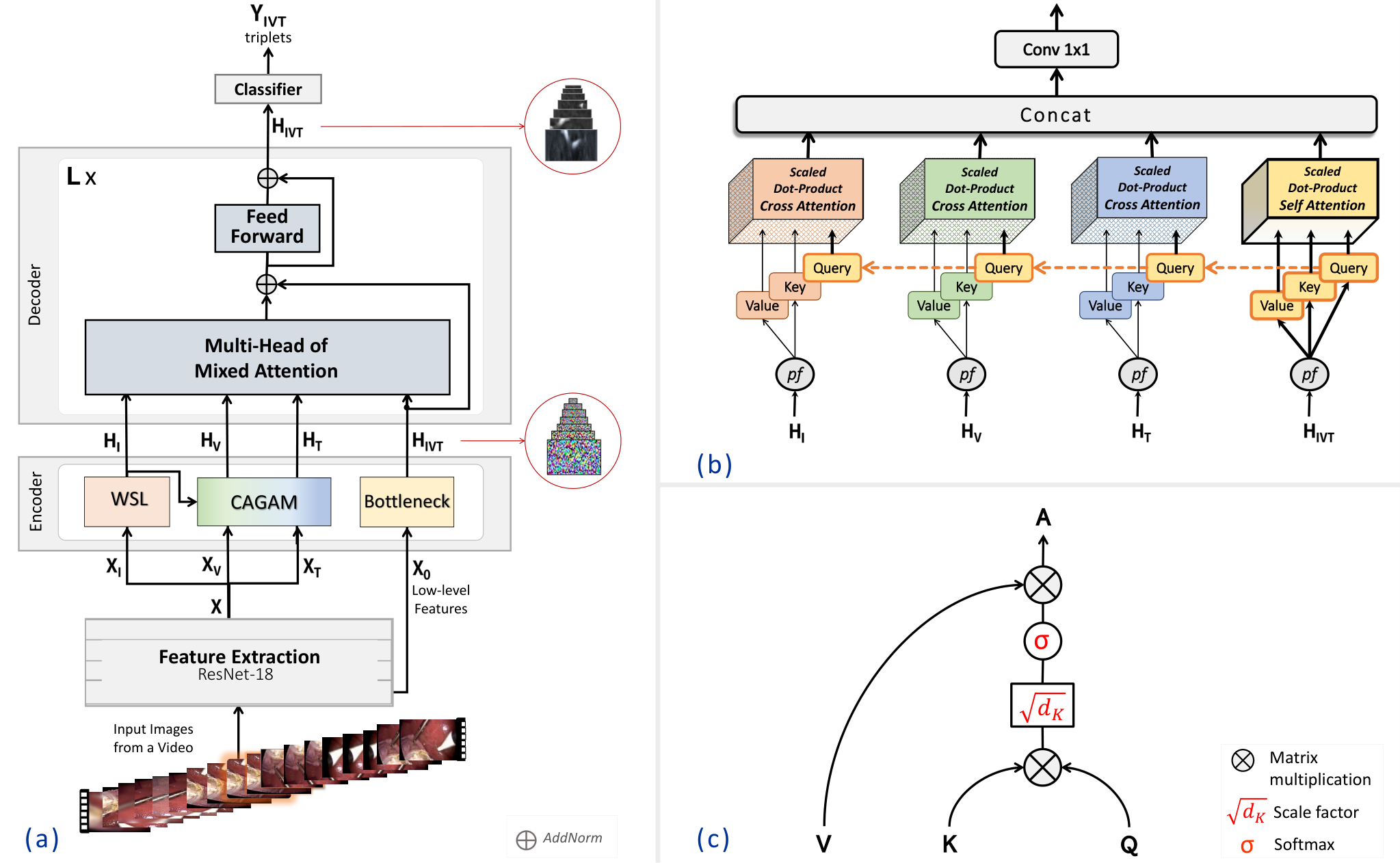
Rendezvous (Medical Image Analysis 2022): attention-based model combining CAGAM and MHMA for state-of-the-art triplet recognition.

The thesis develops three key methods:

  • ConvLSTM Tracker (IPCAI 2019): Weakly supervised surgical tool tracking using only binary presence labels with temporal ConvLSTM modeling
  • Tripnet (MICCAI 2020): The first architecture for end-to-end surgical action triplet recognition with the Triplet Interaction Module
  • Rendezvous (Medical Image Analysis 2022): Attention-based model combining class activation guided attention (CAGAM) and multi-head mixed attention (MHMA) for state-of-the-art triplet recognition

Research Coverage

  • Datasets created: CholecT40 (40 videos), CholecT45 (45 videos), CholecT50 (50 videos) -- collectively the standard benchmarks for surgical action triplet research
  • Scope: From tool detection to fine-grained activity understanding, spanning weak supervision, attention mechanisms, and multi-task learning
  • Impact: Established the surgical action triplet task, adopted by MICCAI challenges (CholecTriplet2021, CholecTriplet2022) and numerous follow-up works
  • Domain: Minimally invasive surgery, computer-assisted interventions

Results and Findings
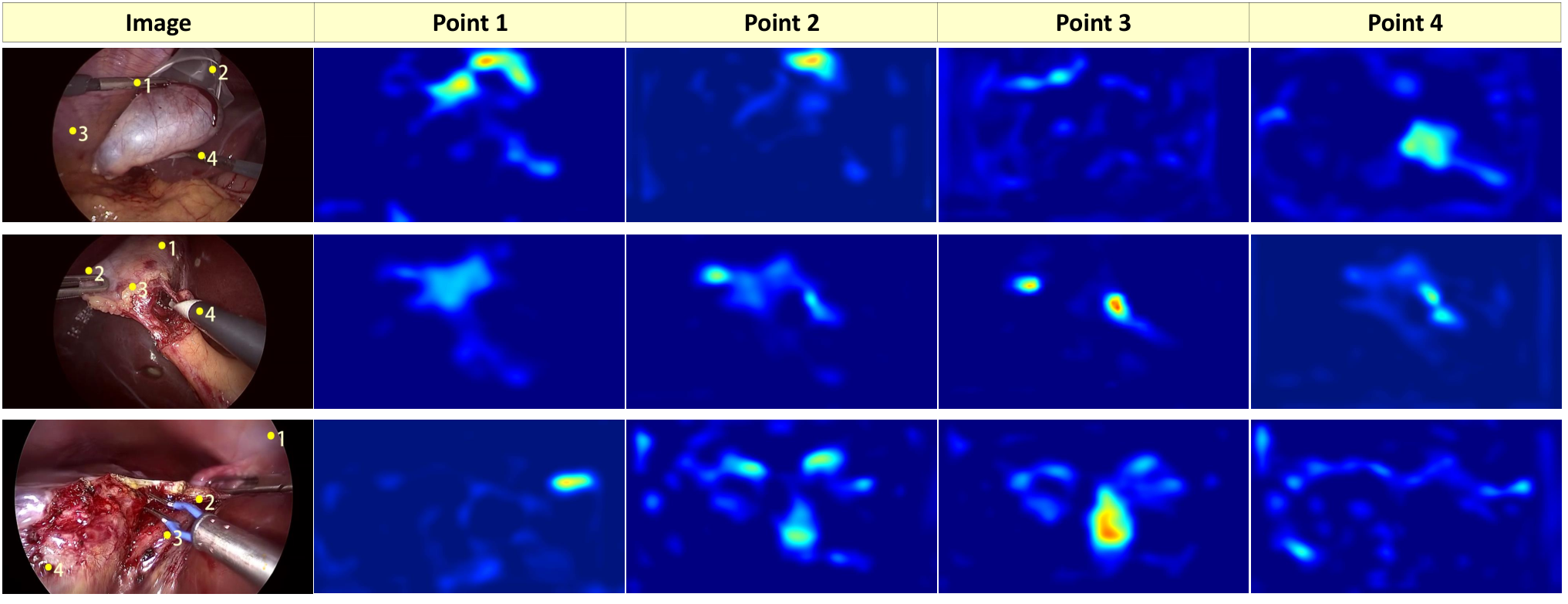
Results and Findings
Learned attention maps from Rendezvous showing the model's ability to focus on relevant instrument-anatomy interaction regions.
  • The surgical action triplet paradigm provides richer surgical understanding than phase recognition or tool detection alone
  • Progressive improvement: ConvLSTM Tracker (tool tracking) -> Tripnet (20.3% triplet AP) -> Rendezvous (26.7% triplet AP)
  • Datasets and methods have been widely adopted, with 500+ citations across the thesis publications
  • Awarded the 2022 Thesis Prize from Université de Strasbourg

Citation

@phdthesis{nwoye2021deep,
  title={Deep learning methods for the detection and recognition of surgical tools and activities in laparoscopic videos},
  author={Nwoye, Chinedu Innocent},
  school={Universit{\'e} de Strasbourg},
  year={2021}
}