↖ All Publications

Medical Image Analysis, Volume 78, 102433

RENDEZVOUS

Rendezvous: Attention Mechanisms for the Recognition of Surgical Action Triplets in Endoscopic Videos

Chinedu Nwoye1,2, Tong Yu1,2, Cristians Gonzalez2, Barbara Seeliger2, Pietro Mascagni1,2, Didier Mutter2, Jacques Marescaux2, Nicolas Padoy1,2

1ICube, University of Strasbourg, CNRS, France 2IHU Strasbourg, France

A transformer-inspired deep learning model that uses class activation guided attention (CAGAM) and multi-head of mixed attention (MHMA) to jointly detect surgical instruments, recognize actions, and identify targets as action triplets from endoscopic video.

Abstract

Out of the description of surgical procedures as a series of triplets of the used instruments, performed actions, and treated anatomies, the recognition of these triplets in surgical videos is becoming a new challenge. Extending the CholecT40 and CholecT45 datasets with 5 additional videos and bounding box instrument annotations, we introduce CholecT50 -- a large-scale dataset for the recognition of surgical action triplets. We propose Rendezvous (RDV) -- a deep learning model that recognizes surgical action triplets directly from videos by leveraging attention at two complementary levels: (1) a class activation guided attention mechanism (CAGAM) that generates instrument-aware spatial maps to focus on the relevant tools in the scene and (2) a multi-head of mixed attention (MHMA) that captures relationships between instruments, verbs, and targets by combining self- and cross-attention to model inter- and intra-triplet component associations.

Demo

Demo
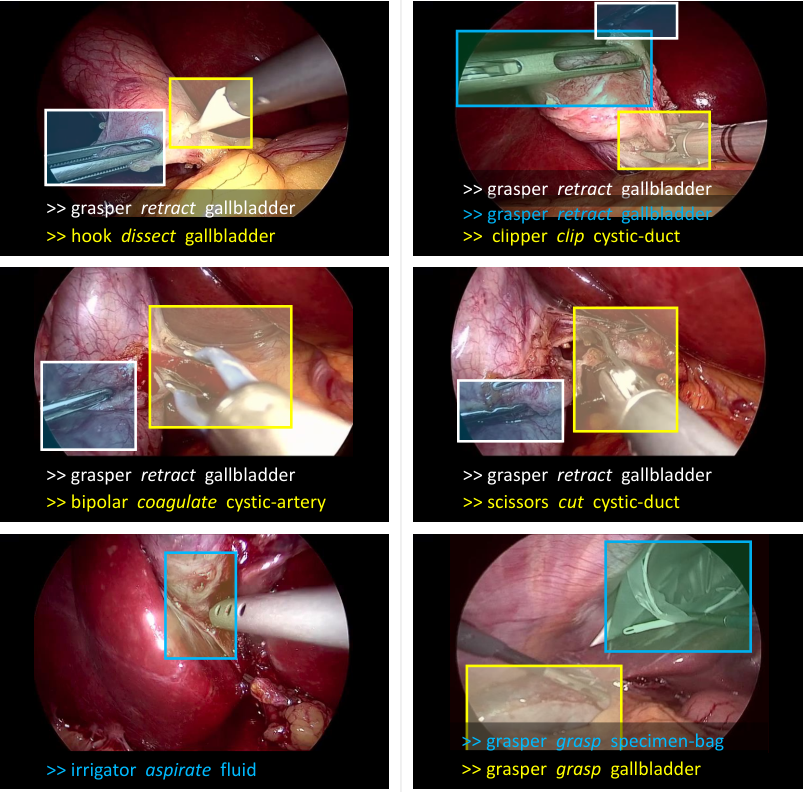
Examples of surgical action triplets detected from cholecystectomy video frames: each triplet captures the instrument, action verb, and target anatomy.

Method

Method
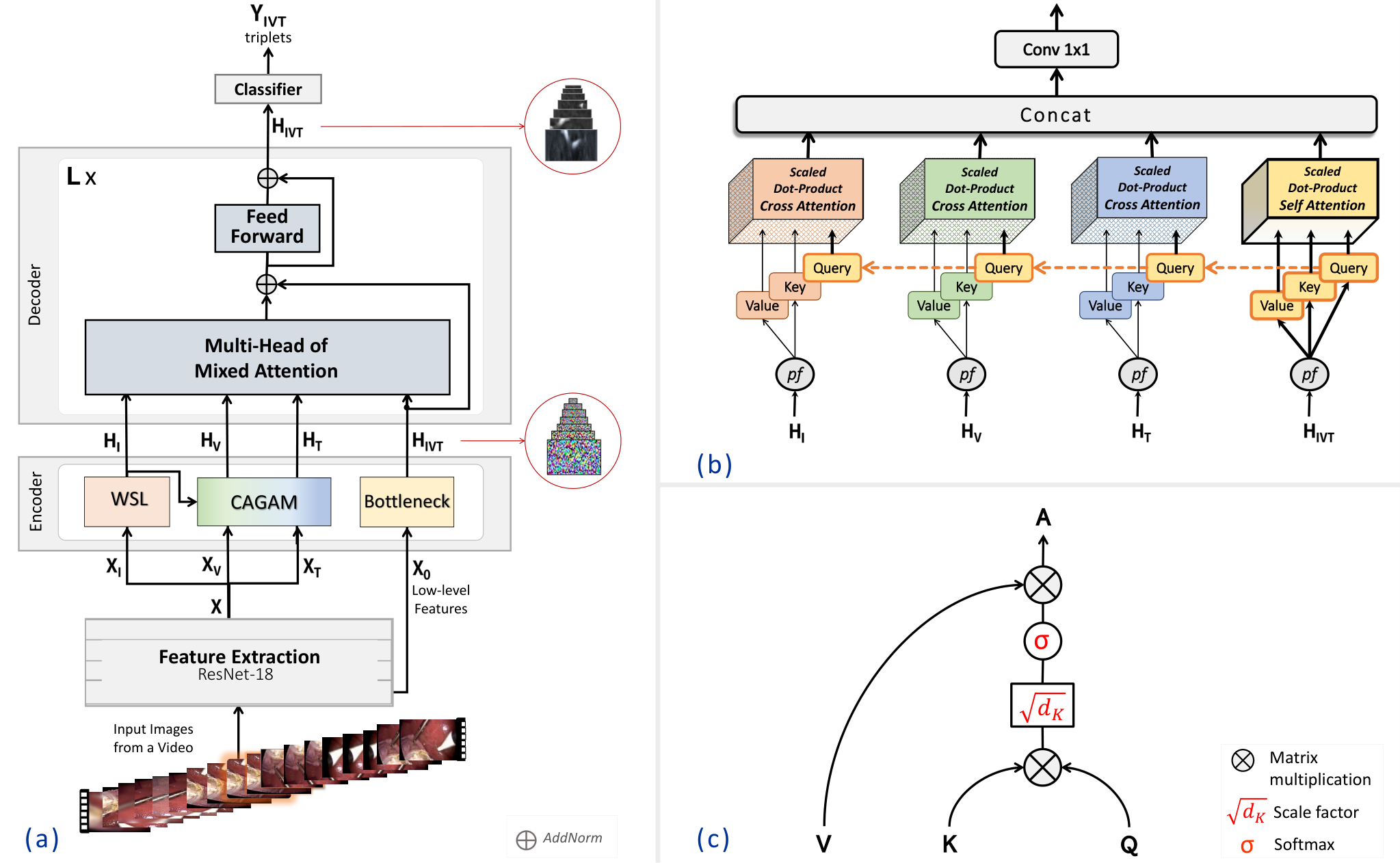
The complete Rendezvous (RDV) architecture: a ResNet-18 backbone extracts visual features, CAGAM generates instrument-aware spatial attention, and MHMA models semantic relationships between triplet components.

The Rendezvous architecture consists of three main components:

  • Encoder backbone: Extracts visual features from each video frame using a ResNet-18
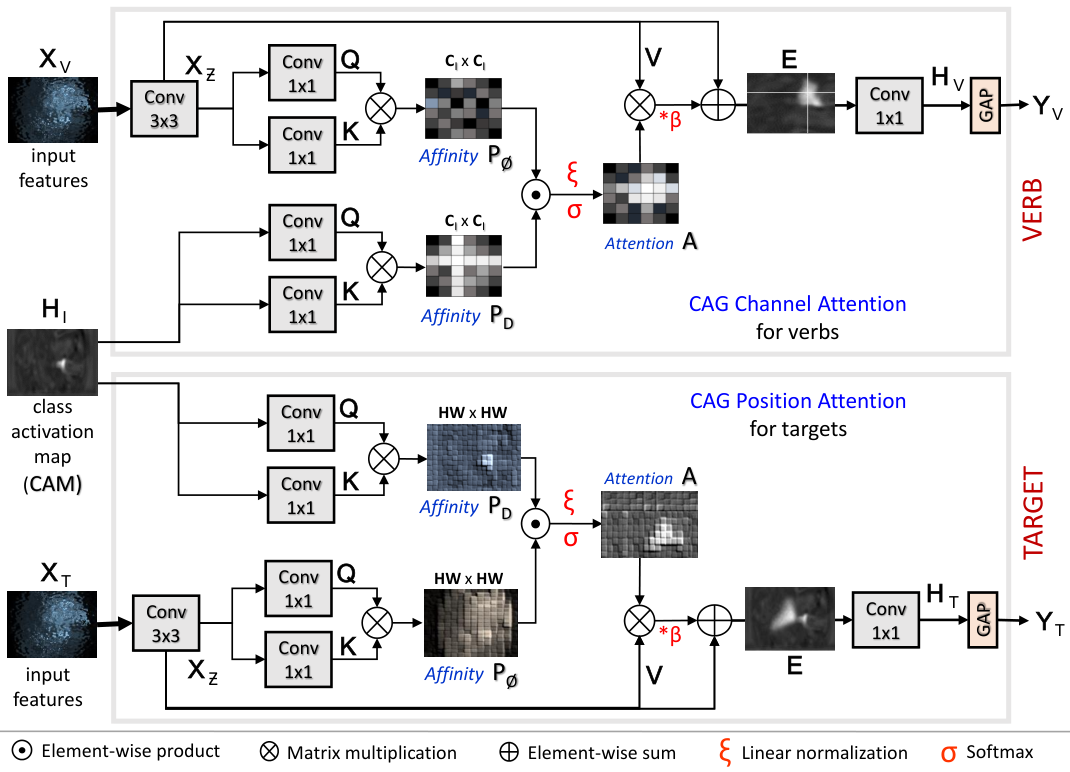
  • Class Activation Guided Attention (CAGAM): Generates instrument-specific spatial attention maps that focus the network on the locations of each detected tool
  • Multi-Head of Mixed Attention (MHMA): Models the semantic relationships between instruments, verbs, and targets through combined self-attention and cross-attention heads
Method
Detail of the Class Activation Guided Attention Mechanism (CAGAM): class activation maps are refined into instrument-specific spatial attention that guides triplet prediction.

Research Coverage

  • Dataset: CholecT50 -- 50 cholecystectomy videos with frame-level triplet annotations covering 100 unique triplet classes (6 instruments, 10 verbs, 15 targets)
  • Scope: The largest study on surgical action triplet recognition at the time of publication
  • Analysis: Comprehensive ablation study on attention mechanisms, comparison with 7 baseline methods, and per-class performance breakdown
  • Domain: Minimally invasive surgery (cholecystectomy)

Results and Findings
Results and Findings
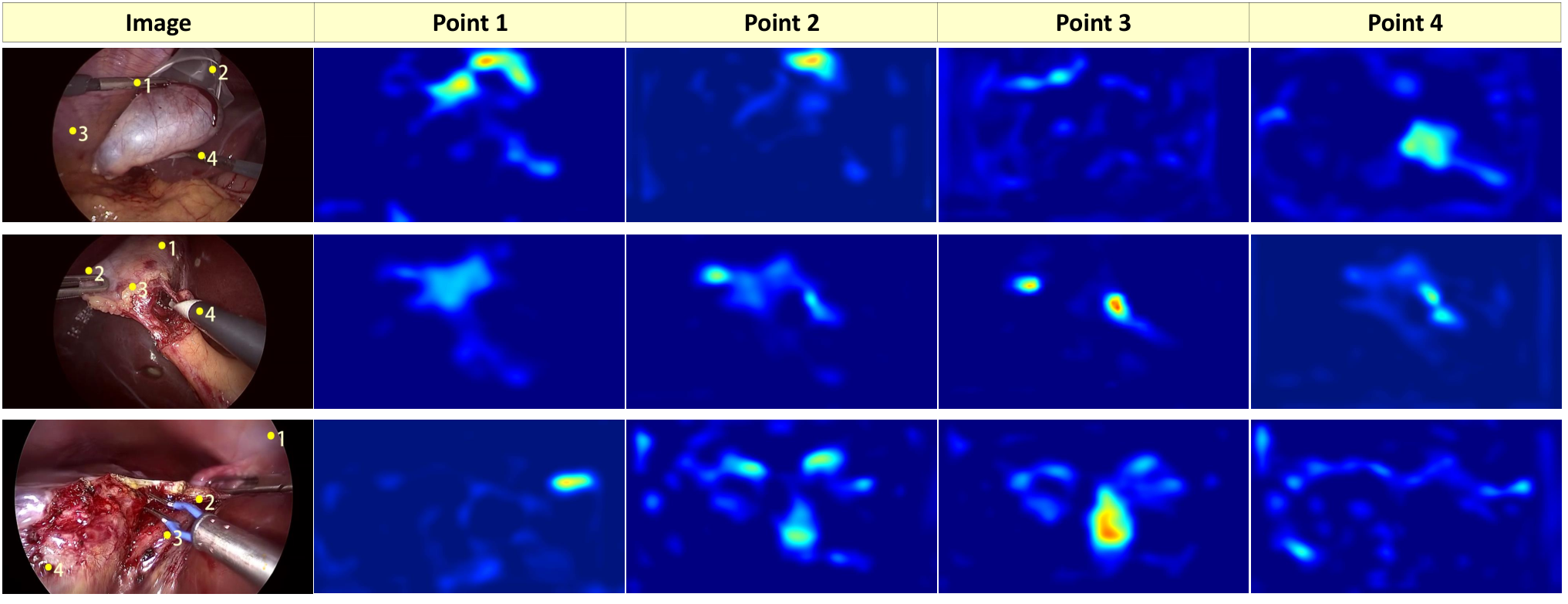
Visualization of learned attention maps: the model focuses on correct instrument locations and their interaction regions with target anatomy.

Rendezvous achieves state-of-the-art performance on the CholecT50 dataset:

  • 26.7% AP on triplet recognition (vs. 20.3% for the previous best Tripnet)
  • CAGAM alone improves triplet AP by +3.4% over the baseline
  • MHMA further improves by +2.8% by modeling inter-component relationships
  • The model runs in real-time, suitable for intraoperative deployment
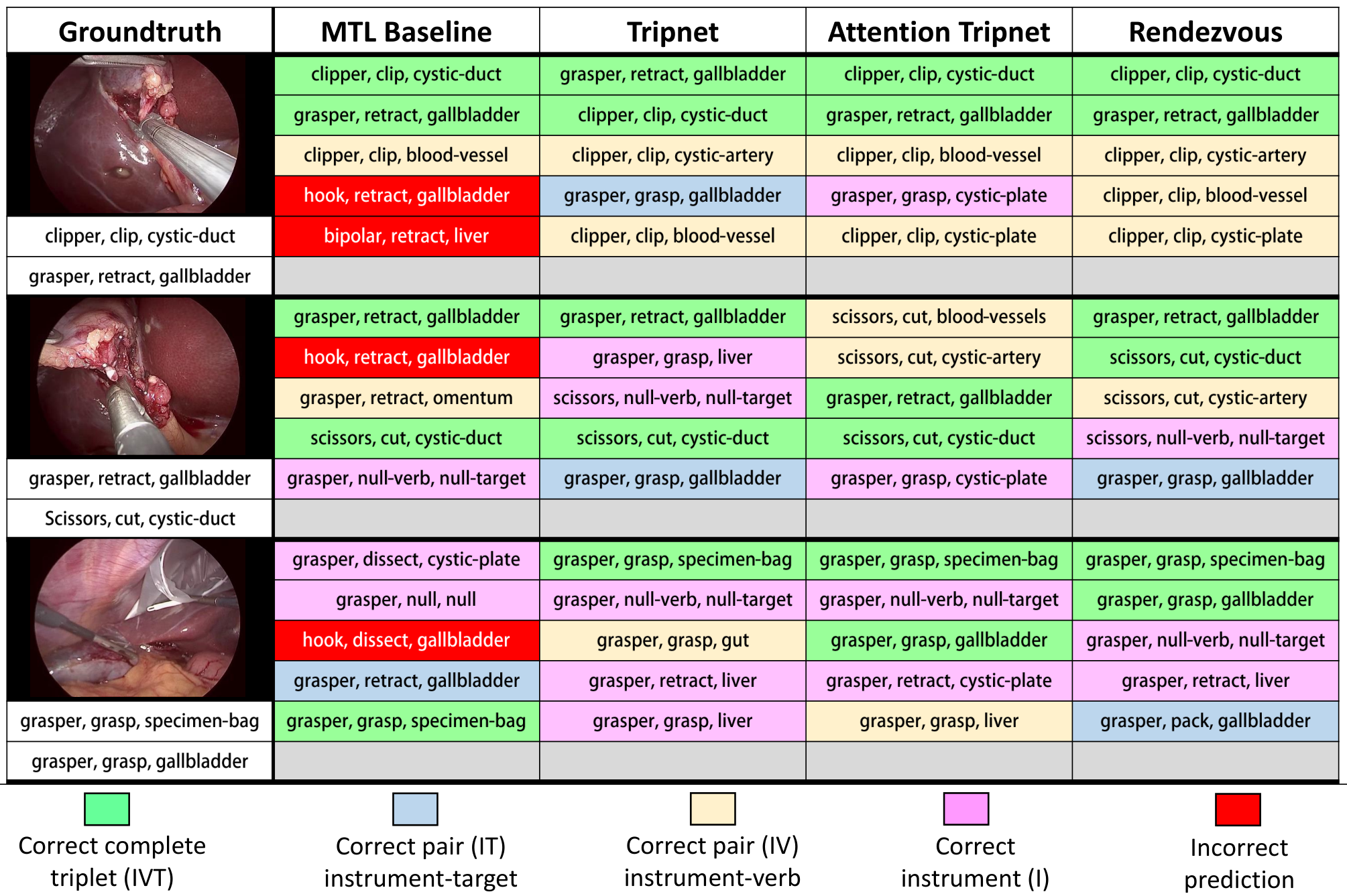
Results and Findings
Qualitative results showing top triplet predictions on challenging surgical scenes with multiple tools and overlapping actions.

Citation

@article{nwoye2022rendezvous,
  title={Rendezvous: Attention mechanisms for the recognition of surgical action triplets in endoscopic videos},
  author={Nwoye, Chinedu Innocent and Yu, Tong and Gonzalez, Cristians and Seeliger, Barbara and Mascagni, Pietro and Mutter, Didier and Marescaux, Jacques and Padoy, Nicolas},
  journal={Medical Image Analysis},
  volume={78},
  pages={102433},
  year={2022},
  publisher={Elsevier}
}