↖ All Publications

MICCAI 2020 · Oral Presentation

TRIPNET

Recognition of Instrument-Tissue Interactions in Endoscopic Videos via Action Triplets

C.I. Nwoye, C. Gonzalez, T. Yu, P. Mascagni, D. Mutter, J. Marescaux, and N. Padoy

ICube, University of Strasbourg, CNRS, France · IHU Strasbourg, France

The first work to formalize surgical activity recognition as action triplets <instrument, verb, target>, introducing both the CholecT40 dataset and the Tripnet architecture for end-to-end triplet recognition from video.

Abstract

Surgical activity recognition is of growing importance for monitoring and understanding surgical procedures. Current state of the art focuses on recognizing short-term activities and long-term phases from surgical videos. In this paper, we propose to model fine-grained activities as action triplets of instrument, verb, and target. We introduce a new dataset, CholecT40, consisting of 40 laparoscopic cholecystectomy videos annotated with action triplet labels. We also introduce Tripnet, a 3-stage architecture that models the triplet components and their associations using a novel attention-based module called the Triplet Interaction Module (TRI). It first detects the instruments, then uses the detected instruments to predict the verbs and targets, and finally associates them into triplets.

Demo

Demo
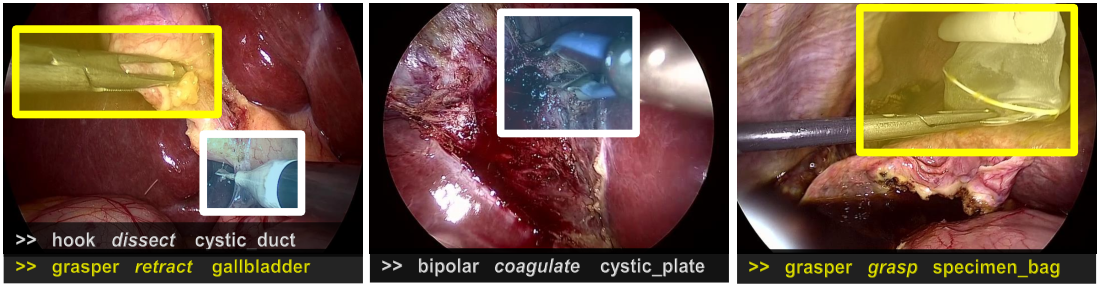
The surgical action triplet task: recognizing fine-grained instrument-tissue interactions as <instrument, verb, target> triplets from endoscopic video.

Method

Method
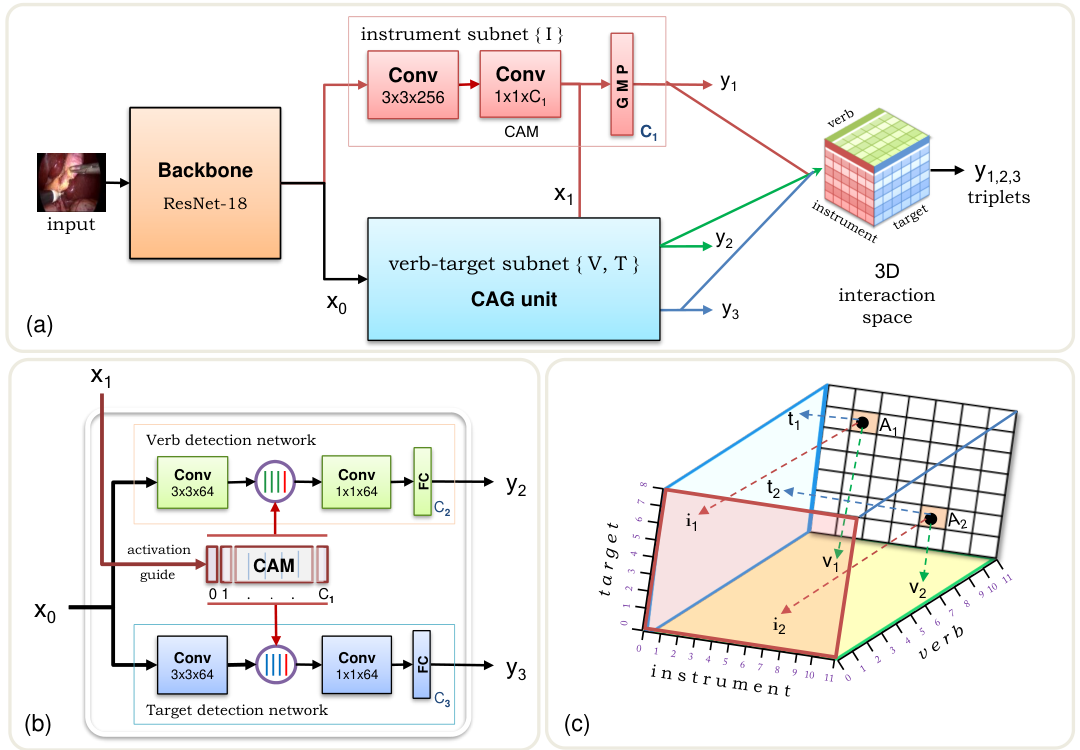
The Tripnet architecture: a 3-stage model that detects instruments, predicts verbs and targets, and associates them into complete action triplets via the Triplet Interaction Module (TRI).

Tripnet is a 3-stage deep learning architecture:

  • Stage 1 -- Instrument Detection: A weakly-supervised CNN detects which instruments are present in the frame
  • Stage 2 -- Verb and Target Recognition: Instrument features are used to predict the associated actions and anatomical targets
  • Stage 3 -- Triplet Interaction Module (TRI): An attention module that associates the three components into complete triplets by modeling their dependencies

Research Coverage

  • Dataset: CholecT40 -- 40 cholecystectomy videos with 127,385 frames annotated with 100 triplet classes (6 instruments, 10 verbs, 15 targets)
  • Scope: First large-scale study of fine-grained surgical activity as action triplets
  • Analysis: Comparison with multi-task learning baselines and ablation on triplet association strategies
  • Domain: Laparoscopic cholecystectomy

Results and Findings
Results and Findings
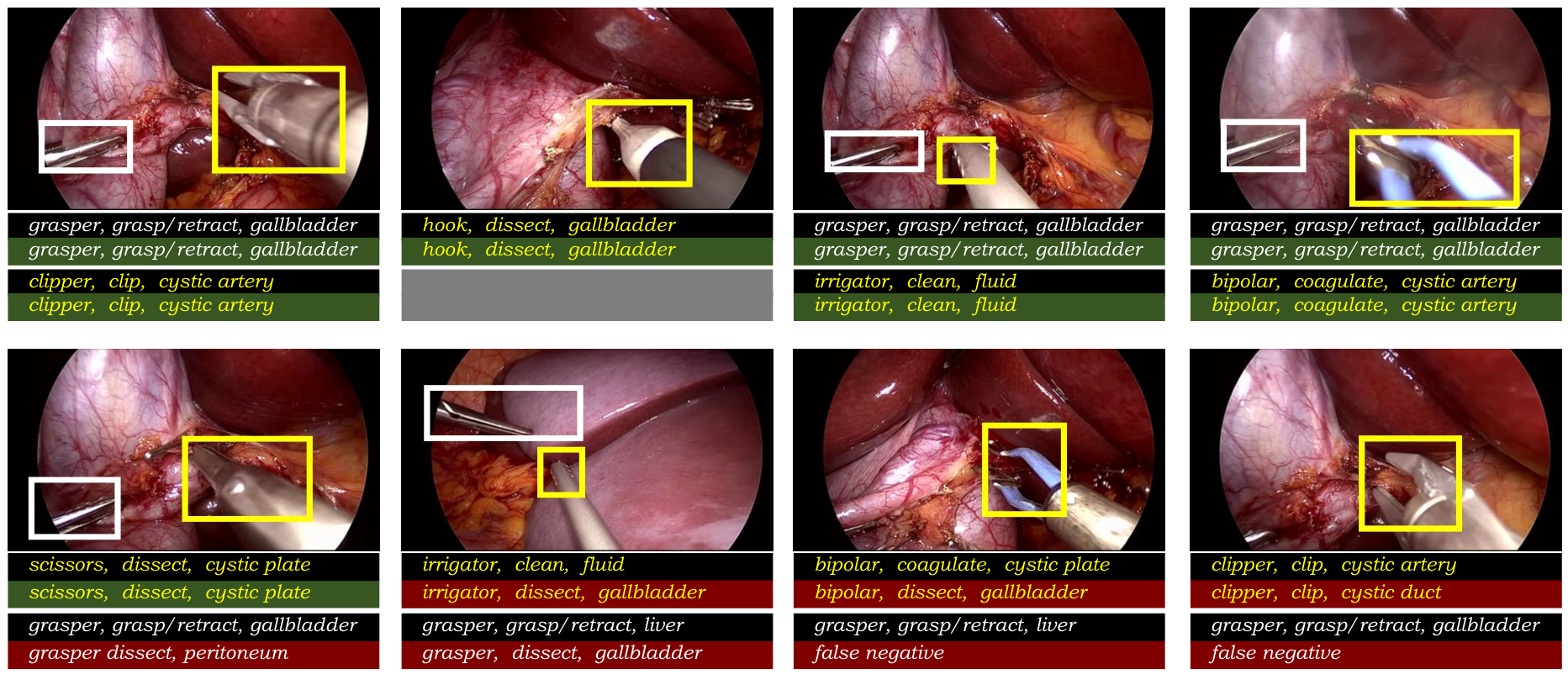
Qualitative results on challenging surgical scenes showing triplet predictions and their confidence scores.
  • 20.3% triplet AP -- establishing the first benchmark for this new task
  • The Triplet Interaction Module (TRI) improves triplet association by +4.1% over naive combination
  • Demonstrates that modeling triplets captures richer surgical context than recognizing phases or tools alone
  • The triplet paradigm has since become a standard task in surgical AI, adopted by multiple international challenges

Citation

@inproceedings{nwoye2020recognition,
  title={Recognition of instrument-tissue interactions in endoscopic videos via action triplets},
  author={Nwoye, Chinedu Innocent and Gonzalez, Cristians and Yu, Tong and Mascagni, Pietro and Mutter, Didier and Marescaux, Jacques and Padoy, Nicolas},
  booktitle={International Conference on Medical Image Computing and Computer-Assisted Intervention},
  pages={364--374},
  year={2020},
  organization={Springer}
}